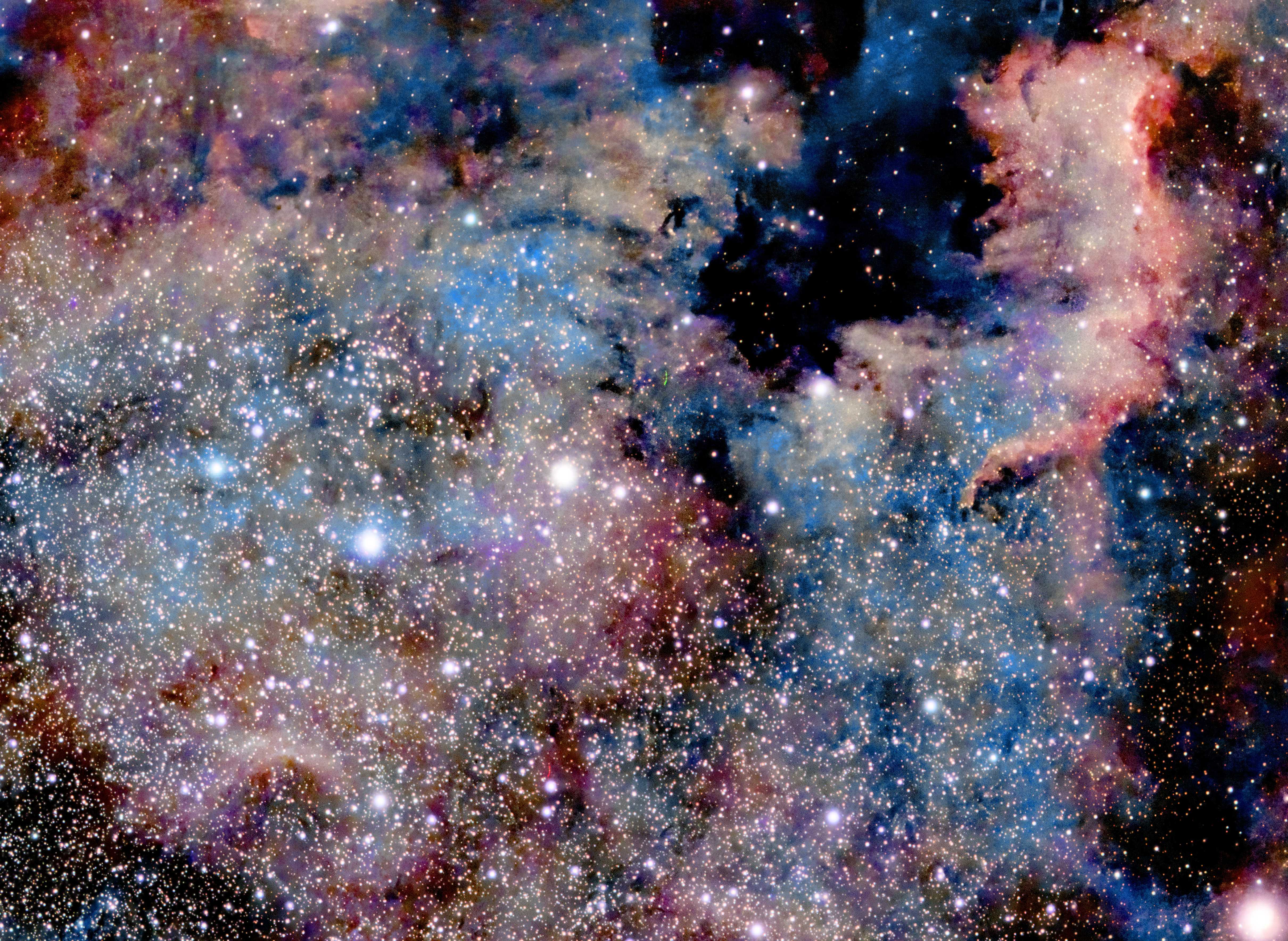
NGC 7000 - The North American Nebula
The North America Nebula (NGC 7000 or Caldwell 20) is an emission
nebula in the constellation Cygnus, close to Deneb (the tail of
the swan and its brightest star) in the night sky. It is named
because its shape resembles North America.
History
On October 24, 1786, William Herschel observing from Slough, England,
noted a “faint milky nebulosity scattered over this space, in some
places pretty bright.” The most prominent region was catalogued by
his son John Herschel on August 21, 1829. It was listed in the
New General Catalogue as NGC 7000, where it is described as a
"faint, most extremely large, diffuse nebulosity.”
In 1890, the pioneering German astrophotographer Max Wolf noticed
this nebula's characteristic shape on a long-exposure photograph,
and dubbed it the North America Nebula.
The North America Nebula covers a region more than ten times the area
of the full moon, but its surface brightness is low, so normally it
cannot be seen with the unaided eye. Binoculars and telescopes with
large fields of view (approximately 3°) will show it as a foggy patch of
light under sufficiently dark skies.
Equipment:
OTA: SVBONY SV503 70ED Refractor f/6
Reducer: SVBONY SV193 0.8x reducer f/4.8
Camera: ZWO ASI183MC Pro Color Cooled Camera (20.1mp)
Mount: Explore Scientific EX02GT with PMC-8
44x60s subs (44 minutes) stacked with SharpCap 4.1 with darks and flats
Processed with GraXpert, Siril, Cosmic Clarity, and Prism